TPT WEEKLY / TRANS-PACIFIC MARKET
Can West Coast Rail Beat the Panama Route? A 40HQ Cost Test
WEEK 36 · AUGUST 31–SEPTEMBER 6, 2026 / 8–10 MIN READ
Panama has eased one draft restriction, but the risk premium remains. A 40HQ cost model shows when a West Coast discharge plus rail move to the U.S. East Coast becomes commercially viable—and what file rate to ask the carrier for.
On September 4, the Panama Canal Authority postponed the Neopanamax draft reduction that had been scheduled for October 1. The maximum authorized draft remains 48.0 feet instead of falling to 47.5 feet.[1] That is welcome news, but it is not a return to normal.
From September 15, total daily booking slots are still set to fall from 34 to 32. The two-slot reduction comes from the Panamax locks; Neopanamax slots remain at nine.[2] At the same time, CMA CGM has announced a $500-per-TEU Panama Canal Adjustment Factor on Far East cargo to the U.S. East Coast and Gulf, effective September 10—equivalent to $1,000 on a 40HQ.[3] The draft pressure has eased for now. The price of uncertainty has not.
Two different valves are at work. Draft determines how much weight a vessel can carry. Booking slots determine when it can transit. Postponing the draft cut removes one layer of cargo-restriction risk, but the booking system still controls the operating rhythm. For a liner operator, the hard question is not whether a ship can get through today. It is whether a weekly schedule can be repeated reliably over the next several rotations.
Panama is not closed. It is turning an East Coast all-water service from a default choice into a route that has to be priced against alternatives.
Panama is repricing uncertainty—not simply capacity
Canal discussions often collapse into one question: how much capacity has disappeared? This week, a more useful question is which East Coast services hold confirmed transit windows, which will queue, and which will pass the delay into the following voyage through speed changes, port omissions or rolled cargo. Capacity may not vanish by one neat percentage. Schedule reliability can still diverge quickly from service to service.
That also explains why a canal surcharge can appear before base freight rates move by the same amount. The carrier wants to price water-level, booking and recovery risk; the market still decides how much of that price can be collected. The surcharge is not a uniform invoice from the Canal Authority attached to every box. It is a carrier’s commercial price for managing uncertainty, and different networks will price that risk differently.
My read is that Panama will support East Coast rate sentiment in the near term, but it is unlikely to create a durable bull market on its own. The more probable result is a two-tier market: reliable sailings command a premium, while weaker or less certain departures discount. For time-sensitive cargo, the conversation then shifts from “How much increase should I accept?” to “Is there another route that can actually deliver?”
That brings an old question back into the room
Could a 40HQ discharge on the U.S. West Coast and move intact by rail to the East Coast? This is not a detour invented for novelty. This week’s rate spread gives us a practical reason to test it. Drewry’s September 3 assessment put Shanghai–Los Angeles at $7,185 per 40-foot container and Shanghai–New York at $9,587—a difference of $2,402.[4]
That $2,402 is the natural budget available for the inland rail move and the port-to-rail interface. If Panama-related charges keep lifting the East Coast all-water rate—or if schedule uncertainty acquires a larger time value—the West Coast option can move from a contingency idea to a quotation worth requesting.
The headline conclusion is simple: the route works operationally, but the public numbers do not currently make it cheaper. Its immediate value is not to replace East Coast all-water service. It is to establish a hard price threshold for the carrier’s IPI or mini-landbridge file rate.
The physical route exists. The procurement logic matters more.
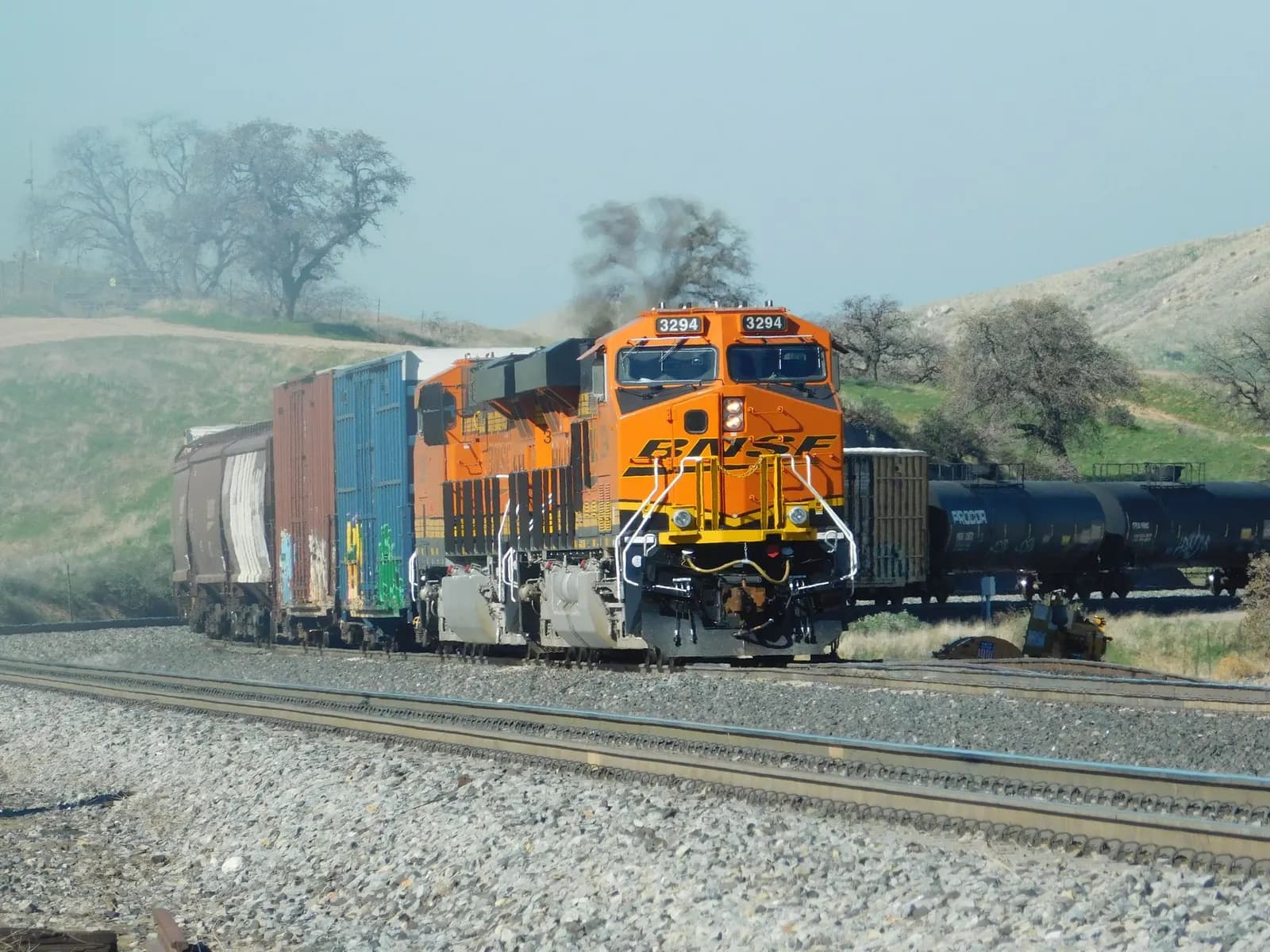
BNSF and CSX publish a Los Angeles Hobart–South Kearny, New Jersey intermodal schedule operating five days a week, with a stated ramp-to-ramp transit of 126 hours.[5] BNSF originates the western movement and organizes the transcontinental handoff; CSX connects the service into the Ohio Valley and Northeast network. For New Jersey and the New York metropolitan area, South Kearny is a commercially relevant endpoint. Cargo destined farther into Pennsylvania, upstate New York or New England needs a fresh final-mile calculation.
This analysis covers one 40HQ marine container moving intact. There is no transload into a 53-foot domestic box. That distinction matters: the container remains carrier equipment as it crosses the country, and the empty return point shifts from the West Coast to the East Coast.
In normal practice, the ocean carrier should quote the complete IPI/MLB product at booking and issue a specific inland file rate. The carrier aligns the ocean leg, U.S. port transfer, rail segment, equipment control and transport document. A mini-landbridge is, by definition, an intermodal product moving through a U.S. port under a through rate and bill of lading.[6]
A Shanghai–Los Angeles CY rate therefore does not automatically give the shipper the right to place the carrier’s 40HQ on any train. The file must define who pays the railroad, where the loaded box terminates, how free time applies, who controls the port transfer, and where the empty is returned. The cost stack below is a feasibility estimate built before that file exists. It is not a bookable market quotation.
This may sound like paperwork, but it is the operating backbone of the move. Keeping the marine box intact ties up equipment longer and changes the repositioning obligation. Rail booking, terminal access, chassis use, cargo responsibility and empty evacuation need one accountable party. The through carrier product buys more than two transport legs; it buys a defined liability line.
A 126-hour train is not a five-day end-to-end promise
The 126 hours published by BNSF is a Hobart ramp-to-South Kearny ramp schedule.[5] It does not include vessel discharge, customs release, port-to-rail transfer, a missed cutoff, destination-ramp pickup or final delivery.
For planning, I would add two to five days of interface time: roughly one to three days for discharge and the West Coast handoff, plus one to two days for availability and pickup at the East Coast ramp. That produces a more defensible internal assumption of seven to ten days from West Coast discharge to East Coast rail-ramp availability. This is my operating allowance, not a railroad service commitment. Peak-season congestion, an inspection or a missed train can widen it.
That becomes the first screen. If the East Coast vessel is only three or four days behind the West Coast arrival, rail may recover little or no time. If the arrival gap is already a week—or if the Panama transit window is unstable—the rail option becomes far more relevant.
Without a file rate, use a three-part feasibility estimate
The planning formula is straightforward: West Coast port rate + cross-country rail proxy + port/rail interface allowance. For the rail segment, I use InTek’s published 2026 Los Angeles–Savannah ramp-to-ramp example of $4,200–$4,800.[7] It is a useful indication of transcontinental cost magnitude, but it is not a Los Angeles–New Jersey 40HQ carrier file rate, and the public page does not specify whether all fuel components are included.
Why use it at all? Because no public page provides the current BNSF/CSX 40HQ file price to South Kearny. The Los Angeles–Savannah sample is at least a verifiable West-to-East ramp benchmark. It cannot deliver precision, but it can tell us whether the inland leg is likely to cost hundreds, one or several thousand dollars.
Scroll across to compare all columns
| Cost component | USD / 40HQ | Basis |
|---|---|---|
| Shanghai–Los Angeles, port to port | $7,185 | Drewry, Sept. 3; 40-foot container |
| Cross-country rail planning proxy | $4,200–$4,800 | Published ramp-to-ramp sample; not an LA–NJ 40HQ file rate |
| Port/rail interface contingency | $500–$1,000 | Author planning allowance; an all-in file may include part of it |
| Estimated West Coast + rail total | $11,885–$12,985 | To an East Coast rail ramp; final delivery excluded |
| Shanghai–New York direct reference | $9,587 | Same Drewry weekly index |
| Estimated premium for the rail option | +$2,298–+$3,398 | Versus the Shanghai–New York reference |
Planning estimate only. It is not a carrier quotation or a bookable market rate.
On this basis, the West Coast-plus-rail option lands at about $11,885–$12,985 to an East Coast rail ramp. That is $2,298–$3,398 above the $9,587 Shanghai–New York reference—and final drayage to the consignee is still excluded. At today’s public price relationship, this is not the cheaper routine route.
The $500–$1,000 interface allowance is intentionally not broken into a dozen falsely precise line items. It is a planning buffer for terminal transfer, drayage or chassis exposure, documentation and location-specific charges. An on-dock, all-in carrier file may absorb part of it. An off-dock transfer can exceed it. Without a named port pair and rail ramp, additional precision would be theatre.
Published rail examples also cut both ways. An ocean carrier may secure a file below public retail levels because of volume commitments, equipment-repositioning needs and railroad contracts. In a tight market, fuel, box availability and terminal conditions can push the other direction. The model is not trying to quote on the carrier’s behalf; it gives the shipper a place to start the negotiation.
The useful output is not the $12,985 high case. It is the file-rate threshold hidden inside the comparison.
Because the ocean-rate spread is $2,402, the carrier’s all-in inland increment above the Los Angeles port rate must be no more than $2,402 to match the direct New York reference. If the file excludes $500–$1,000 of interface costs, the acceptable stand-alone rail quote falls to roughly $1,400–$1,900. Above those thresholds, the shipper needs a time or reliability benefit to justify the premium.
Two examples make the decision tangible. If the carrier quotes an all-in inland increment of $2,200, the combined cost is $9,385—$202 below the New York reference. The route is in the commercial conversation. If the increment is $3,200, the total is $10,385, or $798 above direct. The question is no longer whether $798 is expensive in isolation. It is whether earlier arrival or lower disruption risk is worth $798 for that cargo.
The endpoint must also be normalized. A New York port rate and a South Kearny ramp rate both exclude final delivery, so they are usable for a first-pass comparison. If the warehouse sits much closer to one endpoint, add the two drayage legs separately. Many rail concepts do not fail on the transcontinental train. They fail in the last 30 miles through pickup appointments, chassis and local accessorials.
When is the alternative worth a serious quote?
I would request the file when four conditions begin to line up: the East Coast delivery window is already affecting sales or production; a West Coast sailing is materially earlier or more reliable; the consignee is reasonably close to an East Coast rail ramp such as South Kearny; and the carrier has a procurement or equipment-repositioning reason to quote below the public rail proxy. Remove any one of those conditions and the route can remain technically viable but commercially weak.
There is another way to run the test: put a dollar value on delay. If missing a retail launch, starving a production line, triggering a project penalty or postponing cash collection costs more than $2,000–$3,000 per 40HQ, the rail premium may be loss prevention rather than freight overspend. Low-value cargo with ample inventory should not buy certainty it does not need.
Do not ask the carrier only, “What is the rail rate?” Ask for one file that states the gateway, origin and destination ramps, on-dock or off-dock handling, railroad fuel and accessorials, port and ramp free time, weight limits, East Coast empty-return location, validity dates, applicable sailings and whether final delivery is included. Ideally, request two versions: one to South Kearny or another East Coast ramp, and one to the final warehouse. That is how you see whether a low number comes from procurement strength—or from leaving the expensive interfaces with the shipper.
My conclusion for Week 36: Panama can still give carriers a reason to defend East Coast pricing, but West Coast rail is not yet a price substitute on the public numbers. It has, however, moved beyond emergency folklore. It is a quoteable alternative with a measurable threshold.
The canal sets the risk. The file rate decides the route. Before the next surcharge notice arrives, ask the carrier one precise question: can you move this 40HQ to the East Coast for an all-in inland increment of $2,402 or less?
Nick September 6, 2026
Sources
[1] Panama Canal Authority — Advisory A-33: postponement of the Neopanamax draft adjustment
[2] Panama Canal Authority — Advisory A-29: September booking-slot measures
[3] CMA CGM — Panama Canal Adjustment Factor from Far East to U.S. East Coast and Gulf
[4] Drewry — World Container Index, September 3, 2026
[5] BNSF — Faster coast-to-coast intermodal schedules with CSX
[6] OOCL — Mini-Landbridge definition
[7] InTek — 2026 intermodal pricing examples
Information current as of September 6, 2026. The cost model is a feasibility estimate built from public pricing and stated planning assumptions before a carrier IPI/MLB file rate is available. It is not a market quotation. Actual cost and service depend on the carrier, gateway, ramps, equipment control, free time and booking confirmation.
← Back to Insights