TPT WEEKLY
Transpacific rates stay elevated as cargo volumes set the pace of decline
2026 W41 · October 5–11 TPT WEEKLY · Nick Market information as of October 10, 2026, 14:59 China Standard Time (UTC+8)
The first SCFI release after Golden Week showed almost no movement on the US trades. On October 9, the US West Coast base-port rate increased by just $6 from the previous release, while the US East Coast rate slipped by $4. Both remained at their elevated pre-holiday levels.
Scroll across to compare all columns
| SCFI route | September 30 | October 9 | Change from previous release |
|---|---|---|---|
| US West Coast base ports | 7,578 | 7,584 | +0.08% |
| US East Coast base ports | 10,528 | 10,524 | −0.04% |
Unit: USD/FEU, or US dollars per 40-foot container. The releases before and after Golden Week were nine days apart; the percentage changes are calculated from those two observations. SCFI is a public spot-rate benchmark for exports from Shanghai to base ports. Actual booking prices also depend on the Chinese port of loading, sailing date, charges and available space.
Last week's report argued that transpacific rates had reached a turning point: elevated levels could persist for a while, but the momentum for further increases was insufficient and a decline was a matter of time. This week's flat market extends that phase. Holiday disruptions to cargo production and bookings, sailing windows still affected by planned Golden Week blankings, and earlier cargo volumes continue to support prices.
Transpacific rates are expected to continue adjusting downward, with cargo volumes determining the pace. If post-holiday backlogs and replenishment orders sustain vessel loads, the decline will be slower. If new bookings fail to keep pace with returning usable capacity, price adjustments will accelerate.

September imports remain strong as China-origin volumes rise
Descartes' report released on October 8 put September US container imports at 2,546,261 TEU, up 10.3% year over year but down 2.2% from August. China-origin imports reached 924,454 TEU, increasing 4.5% month over month and 21.2% year over year. Their share of total US imports rose to 36.3%, from 34.0% in August.
Overall imports began to ease month over month while China-origin volumes continued to grow. In September arrivals, Chinese cargo remained an important source of support for the transpacific market, providing a relatively strong volume base heading into the post-holiday period.
Arrival data capture cargo shipped earlier; new bookings from China after the holiday relate to the next wave of departures. Production, cargo delivery to the port and ocean transit separate those stages. Strong September imports help explain the volume base carried into October. Maintaining loads on subsequent sailings will require fresh orders and replenishment cargo.
Also on October 8, the National Retail Federation and Hackett Associates' Global Port Tracker said the import peak that had extended through summer and early fall was winding down. Most holiday merchandise had arrived, with the remaining activity shifting toward last-minute replenishment and preparations for early 2027. The report forecast October imports at its covered ports at 2.25 million TEU, falling to 2 million TEU in November, a difference of about 11%.
That forecast covers major US retail import ports and all origins, and describes the arrival cycle. For China–US shipping, the more useful signal is the transition from large holiday inventory builds to replenishment. Volumes can remain substantial, but orders are more likely to be released in batches as inventories turn over, sales develop and delivery deadlines approach. Carriers will need that follow-on cargo to keep returning sailings well loaded.
Growth in September's China-origin imports can coexist with the end of the peak season. Earlier cargo volumes can delay a rate decline; the continuity of subsequent replenishment will determine how long elevated prices persist. As the main holiday inventory build is completed, more of the cargo supporting the next round of sailings will need to come from replenishment driven by actual sales.
Usable capacity recovery depends on calls at Chinese ports
Previously announced Golden Week capacity adjustments extend into post-holiday departure windows. Maersk listed an eastbound blank sailing on TP12 / voyage 641E, with a scheduled Ningbo departure on October 9. Hapag-Lloyd's notice listed WC2, Guthorm Maersk voyage 640E, as having no sailing from Shanghai toward the US West Coast on October 10. These are previously announced plans affecting this week's Chinese loading windows.
When a sailing is cancelled, cargo may shift into adjacent departures, while alternative port calls may preserve some coverage. If factories resume shipping faster than those sailings release space, near-term bookings can remain concentrated. Flat prices can still coincide with a later departure date for a particular Chinese port or service.
Capacity recovery also has an operational dimension. Flexport's October 8 market update observed that congestion at Asian origins was easing, while carriers were still omitting port calls to restore schedules. For cargo loading in China, better vessel rotation and the restoration of Chinese port calls need to be considered separately. The former helps the service cycle; the latter directly determines whether cargo at a particular port can load within its original window.
A service can resume regular sailings while still omitting a scheduled Chinese call, leaving usable space at that port unchanged. As Chinese port calls, cargo cutoffs and loading windows stabilise, subsequent sailings can absorb backlogs more readily. Better schedules can then release effective capacity even without an increase in nominal deployment.
This is the main path toward downward rate adjustments after the holiday: blanking windows pass, schedules gradually recover and more sailings become available to carry cargo. Carriers then need more spot-market freight to maintain vessel loads. If replenishment fails to keep up, competition for cargo intensifies. Backlogs still awaiting shipment and local port omissions can keep individual sailings tight and slow the broader decline.
The West Coast and East Coast may recover at different speeds. The $4 decrease in this release's East Coast rate is too small to establish that its supply–demand balance is easing first. The next signal needs to come from China-origin services on the relevant coast, rather than treating these tiny price differences as divergent trends.
Cargo volumes determine the speed of the decline
Freight Right's October 8 market commentary reported slower new bookings during the holiday and carriers largely retaining their late-September pricing structures. Its post-holiday guidance continued to emphasise securing sailing arrangements early, given the potential booking pressure from accumulated orders. This is a forwarder's observation of shipping windows; stable quotes can still coexist with difficulty securing space on a near-term departure.
During October 12–18, the first wave of resumed shipments may include orders accumulated around the holiday. If that cargo concentrates on a small number of sailings, it will support near-term quotes, delaying reductions or keeping initial cuts modest. Once that wave clears, the next round of fresh bookings will offer a better view of the support for subsequent vessel loads. Replenishment across several consecutive windows would slow the decline. If loads depend mainly on the earlier backlog, downward pressure will increase as it is cleared.
From October 19 through month-end, the relative pace of cargo recovery and usable capacity recovery should become clearer. If Chinese port calls stabilise and original departure windows become easier to secure, while new bookings consist mainly of scattered replenishment orders, carriers will face greater pressure to attract cargo and rate reductions may accelerate. Stronger replenishment, or continuing omissions and delays on some services, could produce a slower, staged decline with flat intervals along the way.
Upcoming SCFI movements need to be read alongside bookings and space on the relevant sailings. Consecutive declines accompanied by easier access to departure windows would show the adjustment progressing. Temporarily flat rates and tight near-term sailings would more likely indicate that cargo volumes and supply constraints are slowing the decline. A new round of booking growth sufficient to keep returning capacity consistently full would call for reassessing the downward outlook.
The view carried forward from last week is that downward adjustment remains the main direction for market prices. Post-holiday cargo volumes will determine how long elevated levels last, and the speed and size of each round of reductions.
This article is for market reference only and does not constitute a freight quotation, legal advice or tax advice.
Data and photo sources
Rates: Shanghai Shipping Exchange SCFI; route-level figures reported by Economic Daily, October 9 and Liberty Times Finance, September 30.
Imports and demand: Descartes' September US container import report, released October 8; NRF / Hackett Associates' October 8 Global Port Tracker update. Their statistical coverage differs, and each is used separately here.
Capacity and departures: Maersk's Golden Week sailing notice; Hapag-Lloyd's Golden Week service notice; Flexport's October 8 market update; Freight Right's October 8 China–US market commentary.
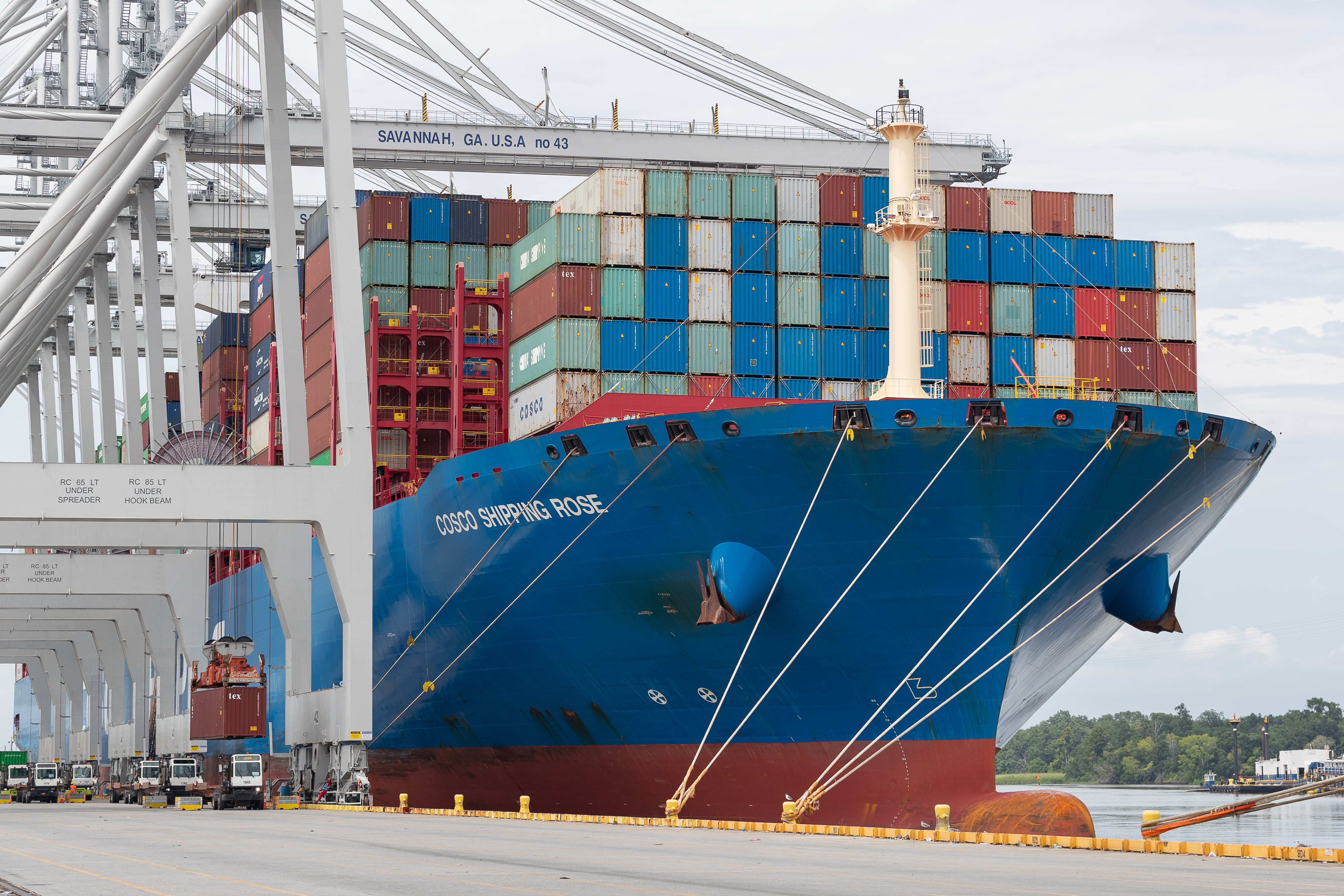
Photo credit: Port of Savannah, Jerry Glaser / U.S. Customs and Border Protection.
Back to Insights