TPT WEEKLY
Transpacific rates edge lower as returning capacity tests fresh cargo demand
2026 W42 · October 12–18 TPT WEEKLY · Nick Market information as of October 18, 2026, 23:55 China Standard Time (UTC+8)
The second SCFI release after Golden Week showed a modest decline on the US trades. On October 16, the US West Coast base-port rate fell to $7,525/FEU, while the US East Coast rate eased to $10,405/FEU, down $59 and $119 respectively from October 9.
Scroll across to compare all columns
| SCFI route | October 9 | October 16 | Week-on-week change |
|---|---|---|---|
| US West Coast base ports | 7,584 | 7,525 | −0.78% |
| US East Coast base ports | 10,524 | 10,405 | −1.13% |
Unit: USD/FEU, or US dollars per 40-foot container. Week-on-week changes are recalculated from the two releases. SCFI is a public spot-rate benchmark for exports from Shanghai to base ports. Actual bookings also depend on the Chinese port of loading, sailing date, charges and available space.
W41 argued that downward adjustment remained the main direction for rates, with post-holiday cargo volumes determining how long elevated levels would last. Both coasts moved lower this week, beginning to bear out that view. With reductions of around 1%, the adjustment is still modest.
The more consequential development is on the supply side. Flexport's October 15 transpacific eastbound market update reported a quick recovery in capacity after Golden Week, with extra loaders entering the market to ease rolled-cargo backlogs. W41's question of whether usable capacity would return faster than new bookings now has a concrete market observation of supply returning.
Transpacific rates are moving from an elevated plateau into a gradual decline. Backlogs can still support individual near-term sailings, but as capacity returns to carry cargo, sustaining high rates will increasingly depend on fresh bookings.

Capacity is returning, but new cargo may not secure space immediately
Returning capacity and tight bookings both appeared in this week's operational observations. In its China–US update published on October 15, Freight Right reported that cargo rolled before or during the holiday was taking priority for available slots, leaving less room for new bookings. Departure dates and terminal receiving windows could also still change.
That can coexist with the supply recovery described by Flexport. Additional or returning sailings first absorb earlier backlogs. Shippers may see more vessels coming back while still struggling to secure the particular departure they need. If extra loaders initially clear rolled cargo, the release of space for fresh bookings comes a step later.
This week's modest rate reductions therefore indicate that prices are beginning to soften while near-term departure windows still face operational friction. It looks more like the early stage of an adjustment: some cargo is gaining negotiating room, while loading certainty at a particular origin and on a particular sailing remains valuable. Lower quotes and the ability to ship on time need to be compared within the same departure window.
At Chinese origins, the practical questions are whether returning sailings actually call at the port, whether terminals receive containers as scheduled, and whether previously rolled cargo continues to occupy subsequent sailings. Higher nominal deployment increases carriers' pressure to attract new cargo only when it becomes usable space at those specific ports and dates.
The Ningbo TP12 / voyage 641E and Shanghai WC2 / voyage 640E examples in last week's report had planned departure dates of October 9 and October 10 respectively, both within W41's announced blank-sailing windows. Cargo affected by those original windows may roll into post-holiday sailings. Changes in subsequent usable space depend on how that backlog and fresh cargo share the returning supply.
The slightly larger East Coast decline this week is also insufficient to rank the two coasts by the pace of recovery. Flexport's deployment observations cover transpacific eastbound, while Freight Right describes China–US booking conditions. Neither provides directly comparable net available space for the West and East Coasts. The conclusion supported at this stage is that prices on both coasts have started to decline, while conditions on individual services may still ease at different speeds.
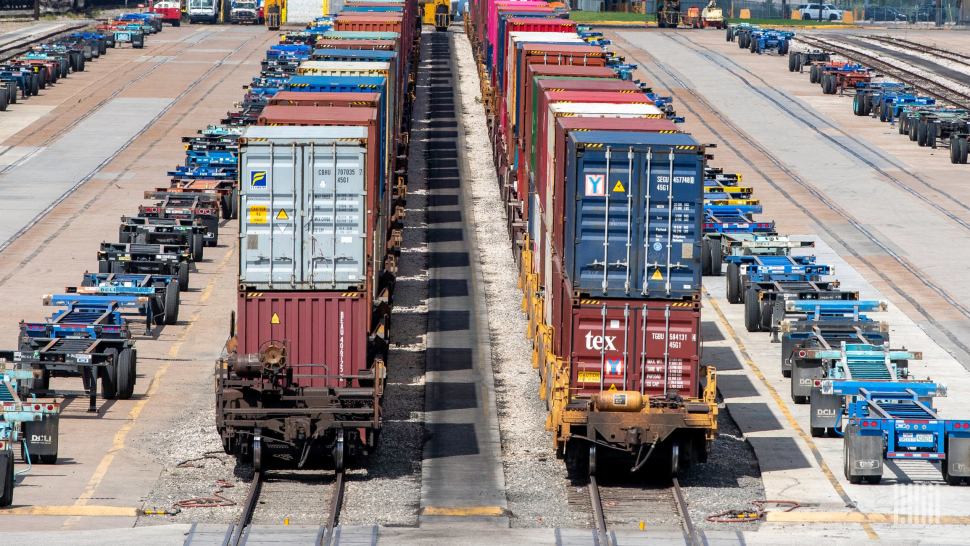
Backlogs support the immediate window; replenishment sets the next one
W41 used the recovery in September's China-origin imports to explain the volume base entering the post-holiday market. Descartes' October 8 release put China-origin imports at 924,454 TEU, up 21.2% year over year. Those arrivals reflect earlier purchasing and loading decisions. They cannot keep substituting for new China-origin bookings in late October.
In the same report, furniture and bedding, HS-94, accounted for 123,574 TEU, or about 13.4% of September's China-origin imports. Home-related products form part of the existing import base, but September's container volume does not directly answer how much replenishment will follow the holiday. Fresh purchasing, inventory preparation and shipping arrangements will determine loads in subsequent windows.
The National Retail Federation and Hackett Associates' October 8 assessment still provides a timing framework for that transition: most holiday merchandise had arrived, with subsequent activity shifting toward last-minute replenishment and preparations for early 2027. At the major retail import ports covered by Global Port Tracker, October imports were forecast at 2.25 million TEU, followed by 2 million TEU in November. Those forecasts describe arrivals from all origins. Current China–US orders sit at a different point in the production and ocean-transit cycle.
This makes a staged decline more likely initially. When backlogs concentrate on particular departures, individual sailings can remain well loaded. Once that backlog is gradually cleared, the same deployed capacity needs more fresh cargo to fill it. If replenishment arrives only in small, scattered batches, carriers have a stronger incentive to compete on price for the next round of freight.
Flexport still expected import demand to support transpacific rates in this week's update. Freight Right also considered it possible for rates to hold into November and December if carriers continued to control capacity. Both suggest that support for elevated levels has not disappeared. W42's modest reductions fit a decline that still has support: demand and local space constraints slow the fall, while returning capacity gradually weakens the conditions sustaining high prices.
The next rounds of vessel loading will test whether the decline accelerates
During October 19–25, the first signal is whether backlogs and new bookings can both be accommodated across adjacent sailings. If returning or additional departures clear rolled cargo and fresh bookings then secure firmer loading windows, competition on rates becomes more likely to continue. If more vessels are available but rolled cargo still carries over from week to week, near-term sailings retain price support.
October 26–November 8 will offer a clearer test of replenishment continuity. Further SCFI declines, accompanied by easier access to loading dates at specific Chinese origins, would strengthen the view that the supply–demand balance is gradually easing. Renewed flat pricing and continuing tight near-term space would instead point to a slower adjustment, or a decline unfolding in stages across different services.
Reassessing the direction would require sustained fresh bookings sufficient to absorb the returning supply and support further increases on subsequent sailings. One full departure, an extra loader or a round of announced rate increases cannot independently establish that the market has returned to broad-based increases.
The question has moved from when rates will begin to fall to how quickly the decline can progress. Downward adjustment remains the main direction. The amount of fresh cargo following the clearance of backlogs will determine whether reductions remain gradual or gather pace.
This article is for market reference only.
Data sources
Rates: Shanghai Shipping Exchange SCFI; route-level figures reported by MoneyDJ, October 16, Economic Daily, October 16 and Economic Daily, October 9.
Capacity and bookings: Flexport's October 15 market update; Freight Right's October 15 China–US update. Earlier planned sailings are documented in Maersk's Golden Week notice and Hapag-Lloyd's service notice.
Imports and demand: Descartes' September US import report, released October 8; NRF / Hackett Associates' October 8 Global Port Tracker. Their statistical coverage differs, and each is used separately here.
Back to Insights